THIRTEEN HUNDRED EMPTY LOTS: HOW A NEIGHBORHOOD BROKE THE CLOT
The Dudley Street Story — Dead Land Made Living in Boston
By Helen Thomas
---
In Roxbury, Massachusetts, in the early 1980s, you could stand on Dudley Street and count the empty lots faster than the occupied ones. Thirteen hundred parcels of land — roughly one-third of the neighborhood — sat vacant or abandoned. Some had been buildings once. Some had been homes. Many had been deliberately burned by their owners, who found it more profitable to collect insurance on a torched building than to maintain one in a neighborhood that banks had written off.
This is what a clot looks like at street level. Not a metaphor. Not an abstraction in a sustainability report. Thirteen hundred pieces of land, held by people who would neither use them nor release them, rotting in plain sight while the families who lived among them watched their neighborhood disappear.
By the time the community organized, the numbers were devastating. Poverty rate: thirty-one percent, nearly double Boston's average. Unemployment: sixteen percent. The population had dropped forty percent since 1950. Banks and insurance companies had illegally redlined the area, denying mortgages and business loans to residents whose only disqualification was the color of their skin and the neighborhood they called home. The Boston Globe called it one of the most blighted places in the country — "a monument to racism and neglect."
The vacant lots collected trash. They collected needles. They collected the particular silence of a place that capital has abandoned — not because nothing of value exists there, but because the people who control the capital decided the value wasn't worth extracting.
This is Meeko's Georgia courthouse story at scale. One street with a bell tower that still rings and empty buildings owned by someone four hundred miles away who can't be bothered. Multiply that by thirteen hundred and you have Dudley Street in 1984.
The Meeting
What happened next did not begin with a grant, a government program, or a corporation's philanthropy. It began with a community meeting.
In 1984, residents of the Dudley Street neighborhood — African American, Cape Verdean, Latino, and white — formed the Dudley Street Neighborhood Initiative. They elected a thirty-five-member board with mandatory representation from four ethnic groups, plus seats for youth, businesses, nonprofits, and religious organizations. The structure was deliberate: no single group could dominate, and the people most affected by the blight would control the response to it.
They were not activists in the way that word is usually deployed — professional organizers with foundation backing and media strategies. They were the people who lived there. The ones who walked past the empty lots on the way to work. The ones whose children played on land that should have been parks. The ones who had watched their neighbors' homes burn and understood, with the clarity that comes from living inside a problem, that nobody was coming to fix it.
So they fixed it themselves.
The Power
In 1988, DSNI did something that no community organization in America had done before and none has done since. They petitioned the Boston Redevelopment Authority for the power of eminent domain over a sixty-four-acre area called the Dudley Triangle — the heart of the blight.
Eminent domain is the government's power to compel the sale of private property for public use. It is the legal tool used to build highways, clear land for stadiums, and — historically — to displace the very communities that Dudley Street represented. It is a power that flows downward: from government to developer to displaced resident.
DSNI turned it around. They convinced the city to grant eminent domain to a neighborhood organization, giving the community the legal authority to force absent landowners to sell their vacant parcels. The owner four hundred miles away who wouldn't sell, wouldn't rent, wouldn't maintain, wouldn't demolish — the human clot sitting on dead capital — could now be compelled to release it.
They created Dudley Neighbors, Inc., a community land trust, to hold the acquired land. The structure was simple and radical: the trust owns the land permanently. Residents own their homes. The land beneath the homes can never be sold to a speculator, never be flipped for profit, never be allowed to return to vacancy. A ninety-nine-year lease ensures that affordability survives the original buyer, the original board, the original generation.
This is structural accountability. Not a pledge. Not a target. Not a sustainability report. A legal structure that makes the flow permanent and the clot impossible.
What They Built
Over the next three decades, Dudley Neighbors transformed thirteen hundred vacant lots into a living neighborhood.
The numbers are verifiable and they are remarkable.
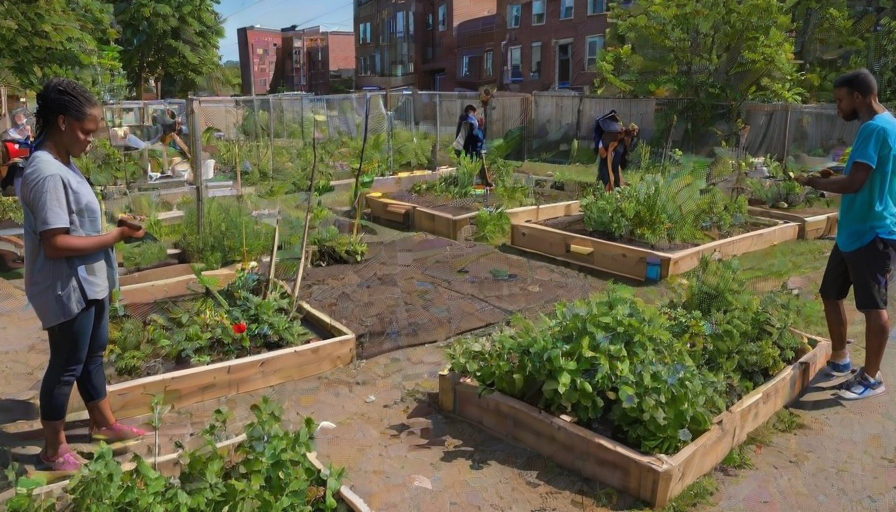
Two hundred and twenty-seven affordable housing units built on formerly vacant land: ninety-seven single-family homes, seventy-seven cooperative units, fifty-three rental apartments. Seven affordable commercial spaces. Parks, community gardens, orchards, a greenhouse, playgrounds, an urban farm that grows food for local consumption on land that used to grow weeds and collect garbage.
Fifty percent of property owners in the trust are low-income. Eighty percent are lower-middle income. Every home is restricted to buyers earning under eighty percent of the area median income. The land trust structure means that when a family sells, they sell at an affordable price — the land beneath their home belongs to the community, not the market. The family builds equity. The neighborhood stays accessible. The cycle of speculation, displacement, and vacancy that destroyed the community in the first place cannot repeat.
These are not projections. These are buildings you can stand in front of, families you can talk to, addresses you can verify in Boston's property records. The land that was dead is now lived on. The capital that was frozen now circulates through a community that banks once refused to serve.
The Test
Every methodology needs a stress test. Dudley Street got one in 2008.
When the financial crisis hit, predatory lending collapsed the American housing market. In Boston, seven hundred and thirteen homes were foreclosed in the first seven months of 2008. Neighborhoods that had recovered from decades of disinvestment were gutted again in months. Families who had scraped together down payments on homes they were told they could afford lost everything when adjustable rates adjusted and the fine print became the headline.
In the Dudley Street community land trust, the number of foreclosures during that period was zero.
Not low. Not reduced. Zero.
Since 1988, across all one hundred and seventy-two homeownership and cooperative units in the trust, there have been four foreclosures. Total. In nearly four decades. The land trust restricts mortgage terms to reasonable rates from approved lenders. When a homeowner faces hardship, the trust intervenes — not as a charity but as a structural safeguard built into the system from the beginning.
This is the number that separates a story from evidence. When the system designed by banks and developers and speculators broke — when the Fortune 500 model of housing finance collapsed under the weight of its own greed — the community land trust held. The structure worked not because the people in it were luckier or smarter but because the structure was designed to absorb exactly the kind of shock that the conventional system was designed to profit from.
Zero foreclosures. That's not a feel-good statistic. That's a proof of concept.
The Echo
Dudley Street is not just a neighborhood. It is a template.
When DSNI demonstrated that a community land trust could transform vacant land into permanent affordable housing — and that the model could survive a financial crisis that destroyed conventional housing around it — other communities noticed. The Greater Boston Community Land Trust Network formed in 2015 with DSNI as its anchor. Where Boston once had a single community land trust, it now has roughly a dozen.
Nationally, the replication is measurable. In 2024, a survey by the Lincoln Institute of Land Policy counted three hundred and eight community land trusts operating in forty-eight states, the District of Columbia, and Puerto Rico. Fifty-five of those trusts — more than a quarter — were incorporated after 2017. The model is not just surviving. It is accelerating.
DSNI remains the only community organization in America ever granted the power of eminent domain. That particular achievement has not been replicated. But the land trust structure itself — community ownership of land, individual ownership of homes, permanent affordability through ninety-nine-year leases, structural protection against speculation — has spread across the country because it works. Because Dudley Street proved it works. Because zero foreclosures in 2008 is an argument that no developer's marketing brochure can answer.
This is downstream propagation. This is the echo. One neighborhood in Boston said: we will not let absent owners hold our land hostage. We will not let speculators decide who can afford to live here. We will own the land collectively, build homes individually, and structure the system so that what happened to us can never happen again. And three hundred and eight communities across America heard that and said: we'll do the same.
The Measurement
Apply the Flow 500 rubric to Dudley Street:
Commitment with Capital: Community invested decades of organizing, won eminent domain, acquired thirty-plus acres, built two hundred and twenty-seven housing units. Not a pledge — built infrastructure. Score: 18.
Transparency on Failure: DSNI publishes community reports, holds open board meetings with mandatory diverse representation, documents ongoing challenges. The work is visible because the governance requires it. Score: 16.
Scope Integrity: The land trust model captures the full scope — not just the homes but the land beneath them, not just the buyers but future generations, not just the buildings but the commercial spaces, gardens, and community infrastructure. Nothing is excluded for convenience. Score: 17.
Structural Accountability: Ninety-nine-year land leases. Community land trust governance. Mandatory ethnic representation on the board. Eminent domain authority. The structure outlasts any individual leader or board member. Score: 19.
Downstream Propagation: Three hundred and eight CLTs in forty-eight states. Model accelerating — fifty-five new CLTs since 2017. DSNI is the acknowledged template. Score: 17.
Total: 87/100 — Flow Leader.
Why This Story
I've spent my career asking presidents and press secretaries to account for what they've done with the power they were given. The answer, more often than not, is that the power was used to protect the people who already had it.
Dudley Street is the opposite story. Power was claimed by people who had none. Land was recovered from people who wasted it. A legal tool designed to displace communities was turned around to protect one. And the structure that resulted — a community land trust — was so effective that three hundred and eight other communities built their own.
This is not a corporation optimizing its ESG score. This is not a Fortune 500 company pledging net-zero by 2050. This is a neighborhood that was burning and decided to stop the fire, buy the land, and make sure it could never be burned again.
The Flow 500 exists to find this. Not the biggest pile. Not the highest revenue. The clearest flow — wealth that moves through a community and leaves it stronger than it found it.
Thirteen hundred empty lots. Two hundred and twenty-seven homes. Zero foreclosures in the worst financial crisis in eighty years. Three hundred and eight communities that heard the echo and built their own.
That's flow. That's the story. That's what Hero Echo was built to find.
---
Helen Thomas was the daughter of immigrants who built a life from a grocery store in Kentucky. She understood that the rooms that matter are always small, and that the people who change things rarely start with permission.
---
Sources:
- Dudley Street Neighborhood Initiative, founded 1984, Boston, MA. [dsni.org](https://dsni.org)
- Dudley Neighbors, Inc. (community land trust), established 1988
- Loyola University Chicago Center for Urban Research: Dudley Square Eminent Domain Case Study
- YES! Magazine: "No Foreclosures Here" (November 2008)
- Lincoln Institute of Land Policy: 2024 Community Land Trust Survey (308 CLTs in 48 states)
- RioOnWatch: "A Multiethnic Community Land Trust with Eminent Domain Powers"
- Community-Wealth.org: DSNI Organization Profile
- International Center for Community Land Trusts: DNI Case Study
- LabGov: "Development Without Displacement" — Dudley Street Analysis